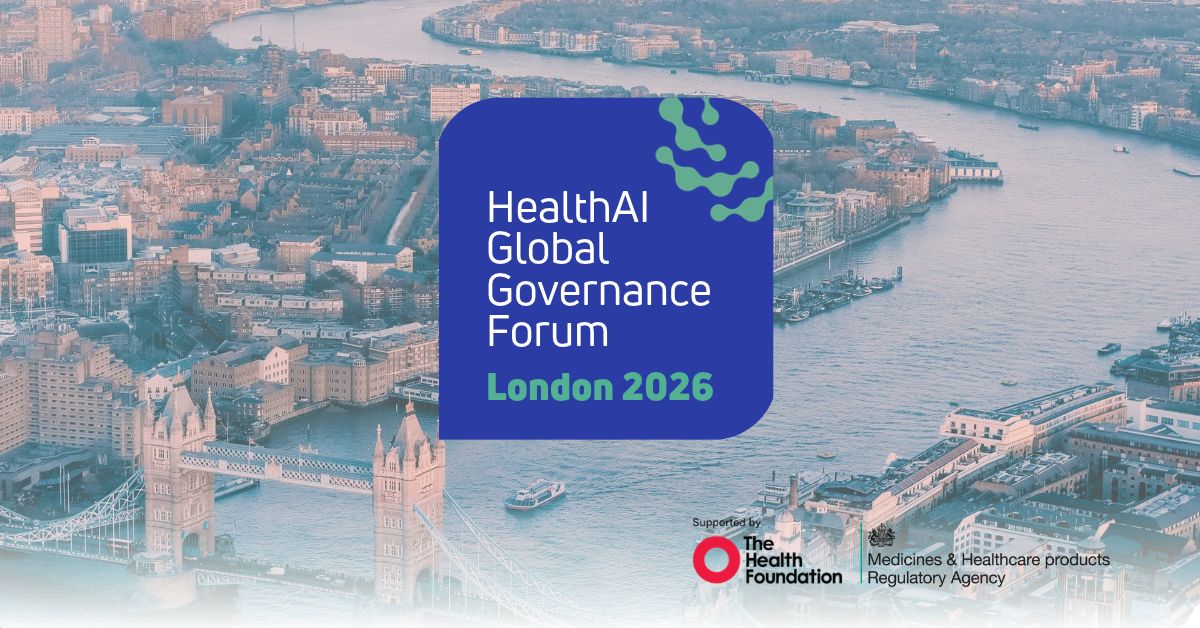
Experts meet in London to explore how responsible AI principles can be translated into practical approaches to regulation, oversight and accountability.
LONDON, UNITED KINGDOM, November 18, 2026 /EINPresswire.com/ — Today, HealthAI – The Global Agency for Responsible AI in Health, welcomes policymakers, regulators, patient and community representatives and health leaders from around the world to its annual HealthAI Global Governance Forum (GGF 2026) in London. Themed Scaling Responsible AI in Health: From Trust to Implementation, GGF 2026 will focus on turning shared governance principles into action to support the safe, effective and equitable adoption of AI in healthcare.
Discussions will examine the challenges of scaling AI responsibly, from monitoring technologies throughout their lifecycle and demonstrating real-world benefits to strengthening health-system readiness, public trust and meaningful participation.
The program features keynote addresses from Dr Jennifer Dixon DBE, Chief Executive of the Health Foundation and Lawrence Tallon, Chief Executive of the MHRA.
As part of GGF 2026, HealthAI will unveil the Global Public Directory of Registered AI-enabled Healthcare Solutions, the first global platform to bring together regulatory information on registered AI-containing medical devices (such as FDA-cleared or CE-marked devices) from national and regional databases into one place. The Directory is designed to give regulators and innovators a unified view across jurisdictions for greater visibility and comparability. Version 1 of the Directory will be available for use following GGF 2026.
Dr Ricardo Baptista Leite, CEO of HealthAI, said: “Bringing together leaders and experts from across the world is essential to addressing a central challenge facing healthcare AI: translating shared principles into meaningful safeguards that work across different health systems. While countries may take different approaches to AI governance, there are practical opportunities to work together to strengthen oversight, improve safety and share learning across borders.
Dr Peiling Yap, Chief Scientist of HealthAI, said: “Implementation research and policies being presented at the HealthAI GGF 2026 highlight the gaps that remain between governance principles and actionable guardrails that could make a difference in bringing a pilot to full-scale, sustained implementation. Through initiatives such as the Global Public Directory, we aim to support international cooperation between regulators and bring greater transparency to the public, healthcare professionals, and solution providers so that they can base their choices on existing regulatory evidence, creating trusted conditions for AI to be adopted safely and effectively in healthcare.”
GGF 2026 takes place at an important time for this year’s host country – the UK – following the Government’s acceptance of all 44 recommendations of the National Commission into the Regulation of AI in Healthcare.
Lawrence Tallon, Chief Executive of the Medicines and Healthcare products Regulatory Agency (MHRA), said: “AI has enormous potential to transform healthcare and improve patients’ lives. Realising that potential depends on getting the conditions right for innovation, adoption and public trust. The UK’s work through the National Commission into the Regulation of AI in Healthcare, alongside the MHRA’s new 2030 strategy, is about creating a regulatory environment that is proportionate, predictable and focused on the full lifecycle of these technologies.
“That means enabling developers to bring safe, effective innovations to patients sooner, while strengthening how we monitor performance in real-world clinical settings and respond as technologies evolve. International collaboration through fora such as the HealthAI Global Regulatory Network is essential if we are to share learning, raise standards and build an approach to AI that gives patients and health systems confidence to adopt innovation at scale.”
Dr Jennifer Dixon DBE, Chief Executive of the Health Foundation, said: “If healthcare systems are to realise the potential of AI, we need better ways of testing and monitoring these technologies in real-world settings, so we can ensure they are safe and effective. At the Health Foundation, we are working with partners across the UK and internationally to develop new approaches to evaluation that can support the NHS to adopt AI at scale. Together with better evaluation, regulatory reforms are essential to keep pace with technological developments, to protect safety and ensure public confidence in AI. The Global Governance Forum is an important opportunity to share what works – and where challenges remain – and help translate innovation into better care for patients.”
Research being presented at GGF 2026 will explore these questions of public trust and readiness in different health-system contexts. A survey conducted by the Call Off Cancer Initiative, with 531 respondents predominantly from northern Nigeria, and presented by co-author Ummi Musa Umar, found that while 86% would trust AI recommended by their healthcare provider, only 28% believed their community was ready for its adoption.1
The findings highlight the importance of understanding community perspectives alongside infrastructure and regulatory capacity when planning equitable AI adoption – issues that will be explored at GGF 2026. Building on the inaugural Forum in Nairobi in 2025, which welcomed more than 240 participants from over 50 countries, GGF 2026 brings together a diverse and inclusive global community, from senior government officials to students and patient advocates, with strong representation from low- and middle-income countries. Together, participants will share expertise, address common challenges and explore practical approaches to AI governance that reflect local priorities, health-system contexts and meaningful participation from the communities affected.
As an official pre-event of the Geneva AI Summit 2027, GGF 2026 will form part of the wider international discussions on responsible AI governance, with insights and connections developed through HealthAI’s Community of Practice supporting continued collaboration beyond the Forum.
About HealthAI’s global AI governance initiatives:
The Global Public Directory of Registered AI-enabled Healthcare Solutions is the first global platform that consolidates regulatory information on registered AI-containing medical devices, giving regulators and innovators a unified view across jurisdictions. Each device entry includes a standardized taxonomy covering intended use per region, registering authorities, manufacturer information, and risk class, as well as, for the first time globally, an optional AI qualification section detailing algorithm type, type of training data, etc, making AI-related solutions visible and comparable worldwide.
The Global Public Directory will also provide the basis for the planned rollout of HealthAI’s Global Early Warning System, designed to enable regulators to collect, analyze and share information on AI-related adverse events, supporting greater transparency and shared learning across jurisdictions.
Stéphane Dupré, Head of Communication
HealthAI – the Global Agency for Responsible AI in Health
communication@healthai.agency
Visit us on social media:
LinkedIn
Bluesky
Instagram
YouTube
X
Legal Disclaimer:
EIN Presswire provides this news content “as is” without warranty of any kind. We do not accept any responsibility or liability
for the accuracy, content, images, videos, licenses, completeness, legality, or reliability of the information contained in this
article. If you have any complaints or copyright issues related to this article, kindly contact the author above.

Media gallery