The Merlin-234CGS is a 2MP Color Global Shutter USB 2.0 Camera built on the Onsemi AR0234 sensor, and Vadzo is positioning it for motion-accurate UAV imaging. A camera on an aircraft vibrates, moves, and sees the ground rush past, and any one of those can bend straight lines in a picture. A global shutter exposes every pixel at the same instant, so the geometry stays true. The Merlin-234CGS adds a high-performance ISP with ROI based auto exposure, auto white balance, and on-board dewarping, which straightens the image from a wide-angle lens before it leaves the camera. It connects over USB 2.0 with UVC compliance, a common interface on the small computers that fly with a UAV, and it offers YUV422, H.264, and MJPEG video formats so that the stream fits the link. Designed for UAV imaging, mapping, and inspection payloads, it supplies undistorted, correctly exposed frames to the flight computer.
FORT WORTH, TX / ACCESS Newswire / October 27, 2026 / Vadzo Imaging, a provider of embedded vision camera products for OEMs and system integrators, today positions the Merlin-234CGS as a 2MP Color Global Shutter USB 2.0 Camera for motion-accurate UAV imaging. Built on the Onsemi AR0234 sensor and part of Vadzo’s USB camera portfolio, the Merlin-234CGS combines a global shutter, a high-performance ISP, ROI based auto exposure, auto white balance, and on-board dewarping in a UVC-compliant module. With this positioning, Vadzo presents a 2MP Global Shutter USB 2.0 Camera for UAV imaging, aerial mapping, and inspection payloads, together with guidance on how to fit video through a USB 2.0 link and how to plan ground resolution.
Why a 2MP Color Global Shutter USB 2.0 Camera Suits Motion-Accurate UAV Imaging
An aircraft is a hostile place for a camera. Motors and propellers shake the airframe, the aircraft moves at several meters per second, and the ground below passes through the frame quickly. Most image sensors read the picture row by row, and when the camera moves during readout, each row captures a slightly different moment. The result is the wobble known as the jello effect, along with skewed vertical lines and bent edges, which can be tolerated for a pleasant video. For imagery used to measure, map, or inspect, geometry matters, and a distorted frame gives distorted results. Survey teams have long known that the cleanest way to avoid the problem is to prevent it at the sensor.
Exposure is the second challenge. A downward-looking camera sees ground that is much darker than the sky at the edge of the frame, and a camera that averages brightness over the whole picture exposes for a bright horizon and leaves the ground too dark. Terrain changes the problem again, since a green field, a gray road, and white snow reflect very different amounts of light. Color shifts with the light too, so a camera needs automatic white balance to keep images consistent across a flight. Manual settings chosen on the ground rarely suit the whole route.
Lens geometry adds a third problem. UAV camera systems often use wide-angle lenses to cover more ground, and wide lenses bend straight lines toward the edges of the frame. Mapping and inspection software needs images without that distortion, and correcting it on the flight computer uses processor time that a small aircraft cannot spare. A camera that corrects the distortion itself saves the computer that work, and it keeps the processing pipeline short and predictable.
The link is the fourth. Small flight computers usually offer USB 2.0 ports, and USB 2.0 is limited in bandwidth. Raw high-definition video cannot pass through it. A camera that advertises 1080p over USB 2.0 without explaining how it fits the data into the link leaves the integrator to find out the limits after the payload is built. A short calculation at the start of the project avoids that surprise.
How a 2MP Color Global Shutter USB 2.0 Camera Preserves Image Geometry
The Merlin-234CGS is built on the Onsemi AR0234, a 2MP (1920 x 1200) color global shutter sensor with a 1/2.6 inch optical format and 3.0 micron pixels. A global shutter exposes and holds every pixel at the same instant and then reads them out, so no row is captured at a different time from another. Vibration and motion no longer bend the picture. The 3.0 micron pixels are large for a 2MP sensor and gather more light, which helps when exposure must stay short to freeze motion, as it does on an aircraft. A short exposure also reduces motion blur from the aircraft’s own movement.
The high-performance ISP finishes the image inside the module. It converts the raw sensor data into a processed color image and applies automatic functions. ROI based auto exposure meters on a selected region of interest instead of averaging the whole frame, so the ground area stays well exposed even when the sky or a bright horizon appears in part of the picture. Auto white balance follows the changing light and terrain. On-board dewarping corrects the distortion of a wide-angle lens inside the camera, so the output is a straight, rectilinear image that mapping and inspection software can use directly. Dewarping is set up for a particular lens, and it trades a little of the field of view at the edges for straight lines, so teams should choose the lens and the dewarping profile together. Vadzo can help set up and verify the profile during evaluation.
USB 2.0 carries at most 480 megabits per second, and practical throughput is lower, roughly 35 to 40 megabytes per second. A raw YUV422 frame uses two bytes per pixel. At 1920 x 1080, one frame is about 4.1 megabytes, and 30 frames per second would need about 124 megabytes per second, or nearly one gigabit per second, which is more than twice what USB 2.0 can carry. This is why the module offers compressed formats. H.264 compresses across frames and gives the lowest data rate for a given quality, which suits a link with limited capacity. MJPEG compresses each frame separately, which uses more bandwidth than H.264 but adds little delay and is simple for software to decode. YUV422 delivers uncompressed pixels and is practical at lower resolutions and frame rates; for example, VGA at 30 frames per second needs about 18 megabytes per second. Teams pick the format that suits the payload, the link, and the software. A short test flight with each format shows how the link behaves under real conditions.
The module is UVC compliant, so Windows, Linux, and Android hosts can open it without a proprietary driver, and ROS-based flight computers can use standard video interfaces. It uses an S-Mount (M12) lens holder, which accepts a wide range of lenses, so a team can choose the field of view that suits the altitude and the task. Ground resolution depends on the lens. With the 3.0-micron pixels and an example 8 mm lens, a UAV at 50 meters sees about 1.9 centimeters of ground per pixel and a footprint about 36 meters wide. The numbers change with the lens and the altitude, and they show why a 2MP sensor suits low altitude and small-area work, and why larger areas call for higher altitude or higher resolution. Teams that need both wide coverage and fine detail can consider a higher resolution module from Vadzo’s portfolio.
Several practical points complete the picture for UAV integrators. Weight and power matter on every aircraft, and the module is USB-powered, so the flight computer supplies its power, and Vadzo can share the power and weight figures once the configuration is confirmed. Vibration isolation of the camera mount reduces image shake that the global shutter cannot remove, since a global shutter prevents skew within a frame but does not stabilize the picture from one frame to the next. A gimbal or a damped mount is still the right answer for stability. Cable choice also matters, since USB connectors can loosen under vibration, and a locking connector or strain relief helps. Finally, the lens should be fixed firmly, and teams should verify focus at the working altitude, because an M12 lens can shift if it is not secured.
Product Overview
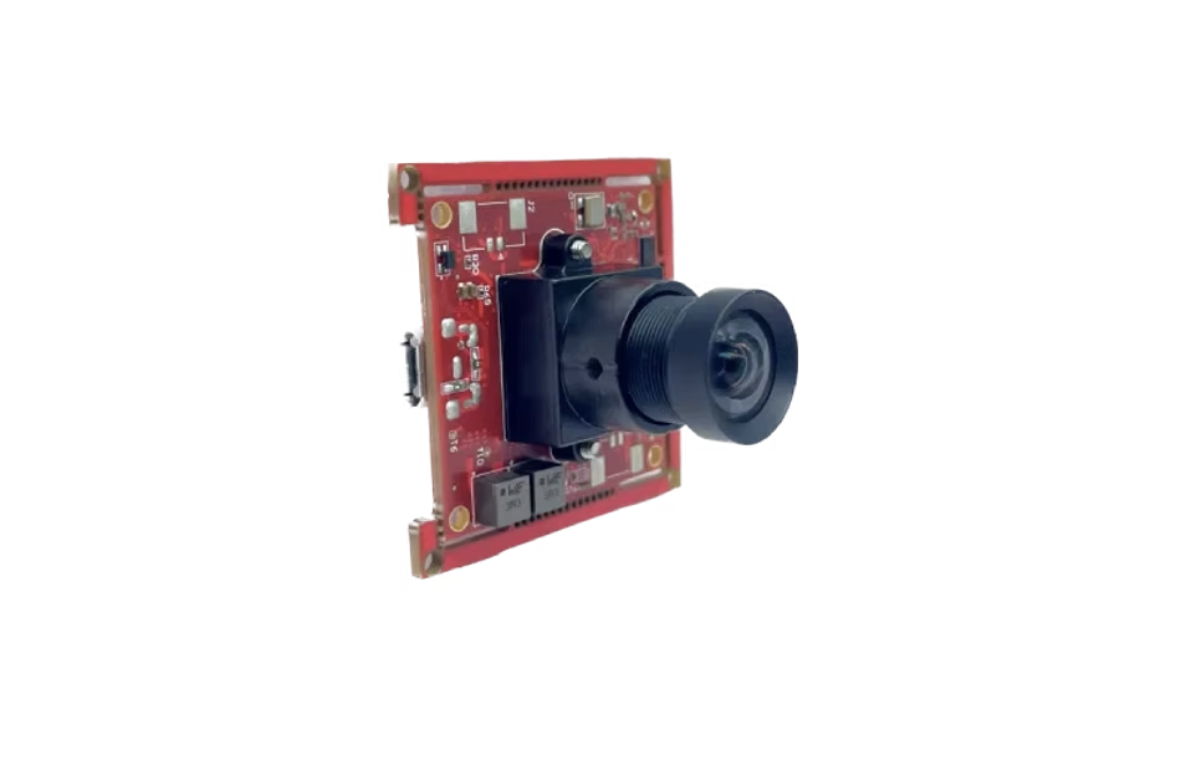
The Merlin-234CGS is a 2MP color USB module built on the Onsemi AR0234 sensor and positioned for motion-accurate UAV imaging. As an AR0234 High Performance ISP USB Camera, it finishes the image inside the module, and as an AR0234 ROI Auto Exposure USB Camera, it meters on a chosen region so the ground stays correctly exposed. The 2MP On-board Dewarping USB Camera designation covers the correction of wide-angle lens distortion inside the camera, and the AR0234 Auto White Balance USB Camera designation covers automatic color control across changing terrain and light. The module combines the sensor, the ISP, and a USB 2.0 controller with an S-Mount (M12) lens holder. It also serves as a 2MP Global Shutter ISP Camera, a 2MP Global Shutter Dewarping Camera, an AR0234 Global Shutter USB 2.0 Camera, and an AR0234 Color USB 2.0 Camera for designs that need a standard interface.
Key specs: 2MP (1920 x 1200) Max Resolution | Onsemi AR0234 1/2.6 inch Sensor Format | 3.0 micron Pixel | Color with Global Shutter | USB 2.0 UVC Interface | S-Mount (M12) Optics
Key Capabilities of the 2MP Color Global Shutter USB 2.0 Camera
Global Shutter Capture for Motion-Accurate UAV Imaging
A global shutter exposes every pixel at the same instant, so a camera that vibrates or flies at speed produces straight lines and true shapes. For aerial imagery that feeds mapping or inspection software, this matters more than almost any other sensor property, because geometric errors in the frames carry through to the final model. The Merlin-234CGS gives UAV payloads that behavior in a small USB module, and the large 3.0 micron pixels let exposure stay short to freeze motion even in modest light. Late afternoon flights benefit most from that sensitivity.
High-Performance ISP for UAV Image Processing
The ISP finishes the picture inside the module, turning raw sensor data into a processed color image and applying automatic functions. A 2MP High-Performance ISP USB 2.0 Camera of this kind saves a small flight computer from running those steps itself, and every unit delivers the same look, which helps when several aircraft share the same payload. Teams that want raw data and custom tuning should discuss a raw sensor module with Vadzo instead. For most UAV projects, a finished image from the first day shortens the path to a working payload. A smaller flight computer can also mean a lighter, cooler aircraft.
Onboard Image Dewarping for UAV Cameras
Wide-angle lenses cover more ground, and they bend straight lines near the edges. Dewarping inside the camera straightens the image before it reaches the flight computer, which spares the computer that work and keeps the pipeline simple. Because the correction is set for a particular lens, teams choose the lens and the dewarping profile together, and they accept a small loss of field of view at the edges in exchange for straight lines. A 2MP Dewarping USB 2.0 Camera that does this work in the module suits mapping and inspection software that expects rectilinear frames, and an AR0234 Dewarping USB 2.0 Camera spares the flight computer a task it would otherwise repeat for every frame.
ROI-Based Auto Exposure for Aerial Imaging
An aircraft sees bright sky and dark ground in the same view, and an exposure that averages the whole frame is pulled toward the sky. ROI based auto exposure meters on a selected region, so the ground area stays correctly exposed regardless of the horizon. Teams place the region over the part of the frame that carries the subject, and they can adjust it as the camera angle changes, for example when a gimbal tilts from a forward view to a downward one. The result is steadier exposure from the first frame of a pass to the last, and a 2MP ROI Auto Exposure USB 2.0 Camera makes that behavior available over a simple USB link.
Auto White Balance for Consistent Aerial Imaging
Terrain and light change during a flight, from green fields to gray roads to bright sand, and from low sun to high sun. Auto white balance follows those changes and keeps colors consistent from frame to frame, which helps reviewers compare images and helps software that uses color. Manual control remains available for teams that prefer to fix the balance for a repeatable survey. A 2MP Auto White Balance USB 2.0 Camera that follows the light in this way keeps frames comparable across a long flight.
YUV422, H.264, and MJPEG Output for USB 2.0 Video Streaming
The module offers three formats because a USB 2.0 link cannot carry raw high-definition video. YUV422 gives uncompressed pixels at lower resolutions and frame rates. H.264 compresses across frames and uses the least bandwidth for a given quality, which suits limited links. MJPEG compresses each frame separately, adds little delay, and is simple to decode. Teams choose the format that fits the payload and the software, and many use H.264 for recording and MJPEG for a low-delay live view. The choice can change from flight to flight.
USB 2.0 UVC Compatibility for UAV Payload Integration
The module is a 2MP Color USB 2.0 Camera that opens as a standard video device with no proprietary driver, and it works as an AR0234 Color Global Shutter USB Camera on the small computers used in UAV payloads. As a USB 2.0 UVC Camera Module with an S-Mount (M12) lens holder, it accepts a wide range of lenses. As a 2MP USB 2.0 Camera Manufacturer, Vadzo supports lens matching, dewarping profile setup, firmware customization, and enclosure design for volume programs. Teams that move from a bench test to a flight test keep the same module and documentation throughout.
“Customers building UAV payloads keep telling us that geometry is what they cannot compromise. A rolling shutter bends the picture when the airframe shakes, and a bent picture gives a bent map. The Merlin-234CGS was positioned around that problem. The global shutter keeps lines straight, the ISP handles exposure and white balance, and the on-board dewarping straightens the wide-angle lens before the image leaves the camera. We are also honest about the limits. The sensor is 2MP, the link is USB 2.0, and a global shutter does not replace a gimbal. USB 2.0 cannot carry raw high-definition video, so we offer H.264 and MJPEG, and we help customers choose. A 2MP sensor also has limits on ground coverage, so we encourage them to calculate ground resolution for their altitude before they commit.” – Alwin Vincent, Product Manager, Vadzo Imaging.
Application Specific Sections: Motion Accurate UAV Imaging in Practice
General UAV Imaging Payloads
Small aircraft carry camera systems for situational awareness, documentation, and live viewing. The Merlin-234CGS works as a UAV Imaging USB 2.0 Camera that delivers straight, correctly exposed frames to a companion computer, and as a Motion Accurate UAV USB Camera, it keeps edges straight during turns and vibration. Teams should check payload weight, vibration limits, and cable routing for their airframe, and they should choose H.264 or MJPEG to match the downlink. Pilots who fly with a live view benefit from the low delay that MJPEG offers, and a recording running in parallel keeps the full quality for later review.
Aerial Mapping and Survey
Mapping software stitches many frames into a single model, and geometric errors in the frames show up in the result. The module serves as a UAV Mapping USB 2.0 Camera and a Drone Aerial Mapping USB 2.0 Camera for low-altitude and small-area work, where the global shutter and the dewarped output keep the frames consistent. Ground resolution depends on altitude and lens, and a 2MP sensor covers a modest footprint per frame, so teams should plan flight lines and overlap accordingly. Teams that survey small sites at low altitude gain the most from a global shutter payload of this kind.
Infrastructure and Asset Inspection
Inspection flights examine towers, roofs, solar arrays, and pipelines at close range, where the aircraft moves slowly and steadily and detail matters. As a UAV Inspection USB 2.0 Camera, the Merlin-234CGS gives reviewers undistorted, correctly exposed frames, and ROI based auto exposure keeps a dark structure readable against a bright sky. Teams should match the lens to the standoff distance and confirm that the dewarping profile suits it, and they should record a short test pass over a known structure to verify that straight edges stay straight in the final footage. Slow, steady passes near a structure reward a camera that keeps edges straight.
Frequently Asked Questions
Q: Why does a global shutter matter for UAV imaging?
A: Vadzo Imaging explains it simply: most sensors read the image row by row, so when the camera shakes or moves, each row captures a slightly different moment and straight lines bend. A global shutter exposes every pixel at once, so the geometry stays true. A 2MP Global Shutter USB 2.0 Camera is especially useful for mapping and inspection, where geometric errors in the frames carry through to the final result. A UAV Imaging USB 2.0 Camera with a global shutter avoids that error at the source.
Q: Can a USB 2.0 camera stream 1080p video from a drone?
A: Yes, with compression. USB 2.0 carries at most 480 megabits per second, and raw 1080p video at 30 frames per second needs nearly one gigabit per second, so the camera must compress the video. H.264 gives the lowest data rate, and MJPEG adds little delay. Uncompressed YUV422 suits lower resolutions and frame rates. Vadzo Imaging helps teams choose the format that fits their payload and their link, and a Motion Accurate UAV USB Camera should be judged by test flights as well as by specifications.
Q: What is on-board dewarping, and why does it help?
A: Wide-angle lenses bend straight lines near the edges of the picture. Dewarping corrects that bend, and doing it inside the camera spares the flight computer the work. A 2MP Dewarping USB 2.0 Camera delivers a straight, rectilinear image that mapping and inspection software can use directly. Vadzo Imaging notes that the correction is set for a particular lens and costs a little field of view at the edges, so teams choose the lens and the profile together. A 2MP Global Shutter Dewarping Camera of this kind is easiest to evaluate with the real lens fitted.
Q: When should a UAV payload use H.264 instead of MJPEG?
A: Use H.264 when the link or the storage is limited, because it compresses across frames and gives the lowest data rate for a given quality. Use MJPEG when low delay and simple decoding matter more, such as a live view for the pilot. Many payloads use both H.264 for recording and MJPEG for the live view. Vadzo Imaging recommends testing both the real link and the real software before choosing, since a USB 2.0 UVC Camera Module can switch formats in software.
Q: Why should UAV payload makers choose Vadzo Imaging as their 2MP USB 2.0 Camera Manufacturer?
A: Vadzo Imaging offers more than a camera module built around a capable sensor. UAV payload makers working with Vadzo Imaging receive a module with a global shutter, a high-performance ISP, on-board dewarping, and three video formats, along with candid guidance on USB 2.0 bandwidth and on-the-ground coverage of a 2MP sensor, plus engineering support for lens selection, dewarping setup, firmware customization, and enclosure design. Vadzo Imaging maintains evaluation kits with no minimum order requirement, so teams can test on their own aircraft before committing to volume production.
Availability
The Merlin-234CGS 2MP Color Global Shutter USB 2.0 Camera built on the Onsemi AR0234 sensor is available now for evaluation and production orders. Evaluation kits include the camera module, S-Mount lens, USB cable, and platform documentation, with no minimum order requirement. UAV teams can test motion handling on their own airframe, check dewarping against their own wide-angle lens, and compare H.264 and MJPEG on their own link before committing to a production bill of materials, which tells them more than a datasheet comparison alone. Teams that need a different lens or dewarping profile can ask Vadzo to review the configuration. Browse the full range of USB camera options at Vadzo’s website or contact Vadzo at support@vadzoimaging.com to request an evaluation unit or discuss OEM integration requirements for UAV imaging, mapping, and inspection programs.
About Vadzo Imaging
Vadzo Imaging is a global provider of embedded vision solutions and delivers high-performance camera technologies and imaging platforms for applications in robotics, industrial automation, UAVs, edge AI, and medical systems. Its products are designed for seamless integration with leading embedded platforms. Vadzo supports customers through hardware customization, firmware development, and module-level drivers, enabling faster development and deployment of vision-based systems across USB, MIPI, GigE, Wi-Fi, and SerDes camera interfaces.
Media Contact
Alwin Vincent
Vadzo Imaging
Email: alwin@vadzoimaging.com
LinkedIn: Vadzo Imaging
YouTube: Vadzo Imaging
X: Vadzo Imaging
SOURCE: Vadzo Imaging
View the original press release on ACCESS Newswire
Media gallery