Vertical Farming Market Size, Share and Research Report By Growing Mechanism (Hydroponics, Aeroponics, Aquaponics), By Farm Structure (Building-Based)
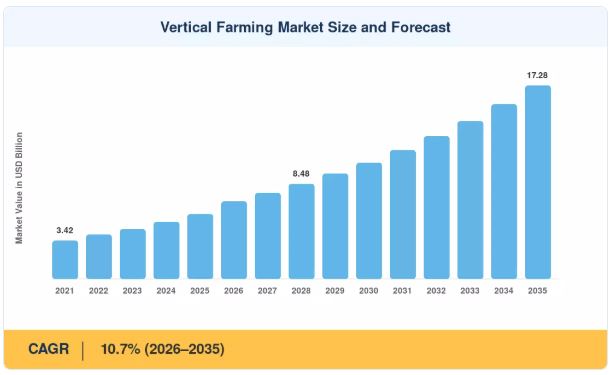
NEW YORK,, NY, UNITED STATES, September 3, 2026 /EINPresswire.com/ — The Global Vertical Farming market was valued at USD 5.78 billion in 2025 and is projected to open the forecast window at USD 6.92 billion in 2026 before reaching USD 17.28 billion by 2035, expanding at a 10.7% CAGR between 2026 and 2035. Two catalysts anchor that trajectory. Singapore’s ’30 by 30′ nutritional self-sufficiency target continues to channel grant capital into high-density growing infrastructure, while the United Arab Emirates has committed more than USD 100 million through its AgTech incentive programmes to domestic produce capacity.
The market has also become considerably more selective after the 2024-2025 wave of operator closures, rewarding balance-sheet discipline over headline square footage. The market’s 10.7% CAGR reflects the convergence of urban food-security policy and public co-investment (~1.9% impact), LED efficacy gains and falling fixture cost (~1.6%), retailer off-take and private-label contracts (~1.4%), and climate volatility and field-crop yield risk (~1.3%) accelerating across the world’s most water-stressed and food-import-dependent economies simultaneously.
The integration of Farming as a Service is creating new opportunities for vertical farming by making advanced agricultural technologies more accessible to growers. Through service-based models, farmers and operators can access cultivation technology, software platforms, monitoring systems, automation, equipment, and technical expertise without making substantial upfront investments. This approach can help smaller agricultural businesses adopt controlled-environment farming while allowing technology providers to generate recurring revenue through subscription and service-based offerings.
Get Full PDF Sample Copy of Report: (Including Full TOC, List of Tables & Figures, Chart) @
https://www.marketresearchfuture.com/sample_request/2779
➤ How Significant Is the Vertical Farming Market’s Growth?
The vertical farming market’s trajectory from USD 5.78 billion in 2025 to a projected USD 17.28 billion by 2035 represents nearly a three-fold expansion over the forecast decade, reflecting the structural shift from high-pressure sodium fixtures and manual nutrient dosing toward tunable LED arrays, closed-loop fertigation, and machine-vision grading lines. The market’s 10.7% CAGR is anchored in a food-security-and-capital-discipline supercycle where sovereign digitisation funds, LED cost curves, and retailer off-take contracts are all converging to reward operators who treat electricity as a hedged input rather than a fixed cost.
Hydroponics commanded 52.7% of the market in 2025 on the strength of proven agronomy and lower system complexity, serviceable by generalist technicians and forgiving of operator error, while aeroponics is the fastest-expanding mechanism at a 14.0% CAGR through 2035, using roughly 90% less water than field cultivation despite demanding tighter maintenance discipline. Aquaponics accounted for USD 1.09 billion in 2025, concentrated in mixed protein-and-produce operations.
Building-based farms represented 67.3% of installed capacity in 2025 because fixed overheads spread across large tray counts, while shipping-container systems posted the strongest structural growth at a 13.2% CAGR, winning on flexibility for institutional buyers such as hospitals, remote mining camps, and military bases that need supply certainty rather than scale. Lettuce and leafy greens retained a 33.6% crop share as the economic backbone of the market, while microgreens are the fastest-growing crop segment at a 15.2% CAGR through 2035, propelled by foodservice demand and rapid turnover.
➤ What Does the Future Hold for the Vertical Farming Market?
Urban food-security policy and public co-investment contribute approximately 1.9 percentage points to the vertical farming market’s CAGR the single highest driver impact. Indoor produce capacity has been categorized as strategic infrastructure by governments. With a goal of 30% domestic nutritional supply by 2030, Singapore’s Agri-Food Cluster Transformation Fund allotted about SGD 60 million to high-tech growing systems, while a significant portion of regional project debt is jointly underwritten by the UAE’s AgTech Loan Guaranty program and Saudi Arabia’s National Agricultural Development program. More than it alters technology, sovereign funding modifies the cost of capital.
LED efficacy gains and falling fixture cost contribute approximately 1.6 percentage points to the CAGR, establishing lighting economics as a primary structural driver. Project viability is determined by fixture economics: dollar-per-photon pricing has decreased by around 60% since 2018, and horticultural LED effectiveness has surpassed 3.6 µmol/J, reducing lighting’s operational expenditure share from approximately 40% to closer to 25% at comparable tariffs. Growers may also shift usage into off-peak windows with dimmable spectrum management, which is important when time-of-use pricing is in effect.
Retailer off-take and private-label contracts add a further 1.4% as supermarkets shift from trial listings to multi-year volume commitments, with roughly 45% of North American commercial grow area commissioned during 2024-2025 tied to a named retail counterparty before construction began, contracts lenders increasingly price as quasi-receivables. Climate volatility and field-crop yield risk contribute a further 1.3% as growing unpredictability in open-field agriculture reinforces the case for climate-controlled, year-round production.
The next phase of the market’s evolution centers on autonomous growing operations, as machine-vision seeding, transplanting, and harvest lines move from pilot to default specification; labour typically consumes 25-35% of operating cost, and full-line automation has demonstrated 30-40% reductions in that line item at scale, positioning autonomy to become a financing precondition rather than a differentiator by 2030.
Platform and licensing economics are also reshaping the competitive landscape as hardware margins compress while agronomic software does not, with the market increasingly resembling a licensing business layered on commodity equipment and control platforms growing faster than any physical component category through 2035.
Electricity is becoming a managed asset rather than a flat-rate input, as the IEA projects global electricity demand growing roughly 3.4% annually through 2026, tightening capacity in several key markets, and facilities that treat lighting schedules as dispatchable load, bidding into balancing markets and pairing with on-site solar or storage, will hold a structural cost advantage over those buying power at flat rates.
Carbon accounting and disclosure are also gaining commercial weight as CSRD reporting obligations now reach thousands of European corporates and retailers push Scope 3 requirements upstream to produce suppliers, making verified low-transport, low-water production a saleable attribute wherever that claim is auditable.
Get access to the full description of the report @
https://www.marketresearchfuture.com/reports/vertical-farming-market-2779
➤ Who Are the Key Players in the Vertical Farming Market?
Concentration in the vertical farming market remains low. The estimated Herfindahl-Hirschman Index sits near 620, with the top five suppliers holding roughly 34-39% of combined equipment and produce revenue. The structure is genuinely fragmented: lighting and controls are dominated by large industrial electronics firms, while growing operations are split among dozens of regional producers, several of which restructured during 2024-2025. Consolidation is likely to accelerate as distressed assets change hands. MRFR identifies the following key participants with estimated revenue share ranges:
• Signify (~9–12% share)
• ams-OSRAM (~5–7% share)
• AeroFarms (~4–6% share)
• Plenty Unlimited (~3–5% share)
• Bowery Farming (~3–5% share)
• 80 Acres Farms (~3–4% share)
• Intelligent Growth Solutions (~2–4% share)
• Freight Farms (~2–3% share)
• Sky Greens (~2–3% share)
• Priva (~2–3% share)
Strategic competition in the vertical farming market is increasingly defined by contracted off-take discipline and proprietary cultivar development rather than headline square footage, with electricity cost and tariff volatility cited as a top structural headwind, contributing an estimated -1.8% drag on CAGR as European industrial rates ran about EUR 0.19/kWh in 2023-2024 against roughly USD 0.08/kWh in the US Midwest, a difference significant enough to determine whether a facility can cover its cost of capital, alongside capital intensity and post-shakeout financing scarcity after disclosed equity financing fell an estimated 55% between 2022 and 2024, narrow crop economics beyond leafy greens, a shortage of skilled growing and controls staff, and grid interconnection and permitting delays.
➤ What Are the Emerging Trends in the Vertical Farming Market?
Several transformational trends are redefining the vertical farming market’s evolution through 2035:
Demand-Response Revenue Stacking: Grow facilities are among the most manageable industrial loads on any distribution network, and by enrolling dimmable lighting in demand-response programs, operators can turn a liability into a hedged asset, receiving capacity payments that offset 5-9% of yearly energy expenditures.
Emerging-Market Franchise Models: Gulf states, Singapore, and coastal India combine water scarcity with import reliance, and by lowering entry capital below USD 150,000 per unit, modular container deployments provide franchise and lease models appropriate for operators lacking balance-sheet depth.
Agronomic Data Monetisation: Recipe libraries mapping spectral, thermal, and nutrient parameters to yield outcomes are becoming licensable intellectual property, with software and control platforms already growing faster than any hardware category, making subscription agronomy the most defensible margin pool in the market.
Pharmaceutical and Nutraceutical Botanicals: Cannabinoid, saffron, and specialty botanical production tolerates production costs an order of magnitude above salad greens, with regulated indoor cultivation offering batch consistency that field growing cannot match, and several European contract manufacturers have begun qualifying vertical facilities to GACP standards.
Waste-Heat and CO2 Symbiosis: Co-locating with data centres, breweries, or biogas plants supplies free thermal energy and enriched carbon dioxide, with Dutch pilot projects reporting 12-18% reductions in combined heating and enrichment costs where symbiosis is engineered from the outset.
Buy Full Research Report:
https://www.marketresearchfuture.com/checkout?currency=one_user-USD&report_id=2779
➤ How Is the Vertical Farming Market Segmented?
The vertical farming market report provides a comprehensive segmentation framework:
By Growing Mechanism: Hydroponics (52.7% share, 2025), Aeroponics (14.0% CAGR), Aquaponics (USD 1.09 billion, 2025)
By Farm Structure: Building-Based (67.3% share, 2025), Shipping-Container-Based (13.2% CAGR), Rooftop & Hybrid (USD 0.47 billion, 2025)
By Component: Lighting (31.9% share, 2025), Climate Control (USD 1.24 billion, 2025), Hydroponic & Fertigation (17.8% share, 2025), Sensors & Monitoring (12.6% share, 2025), Software & Control (14.8% CAGR), Others (6.5% share, 2025)
By Crop Type: Lettuce & Leafy Greens (33.6% share, 2025), Tomatoes (USD 1.05 billion, 2025), Berries (12.4% share, 2025), Microgreens (15.2% CAGR), Pepper (9.7% share, 2025), Herbs (8.6% share, 2025), Others (6.2% share, 2025)
By Region: North America (37.4% share, 2025), Europe (USD 1.49 billion, 2025), Asia-Pacific (13.4% CAGR), South America (3.9% share, 2025), Middle East & Africa (12.9% CAGR)
➤ Competitive Landscape:
The competitive environment includes vertical farm operators, agricultural technology providers, lighting manufacturers, automation companies, software developers, and equipment suppliers. Companies are increasingly focusing on improving crop yields, reducing energy consumption, automating operations, and developing scalable farming models.
Service-based approaches are also becoming increasingly relevant as businesses seek flexible ways to deploy advanced agricultural technologies without bearing the entire cost and complexity of infrastructure ownership.
➤ Future Outlook:
The future of the Vertical Farming Market will depend on continued technological innovation and improvements in economic viability. Automation, AI-powered crop management, advanced LED systems, robotics, renewable energy integration, and data-driven cultivation are expected to shape the next generation of vertical farms.
As cities expand and pressure on natural resources increases, controlled-environment agriculture could become an increasingly important part of global food production. The combination of technology and service-based agricultural models may further broaden access to vertical farming solutions.
➤➤➤ Regional & Country-Level Reports by Market Research Future:
US Vertical Farming Market –
https://www.marketresearchfuture.com/reports/us-vertical-farming-market-14209
➤➤➤ Industry Analysis Reports by Market Research Future:
Digital Door Lock Systems Market
https://www.marketresearchfuture.com/reports/digital-door-lock-systems-market-5135
Mobile Robotics Market
https://www.marketresearchfuture.com/reports/mobile-robotics-market-1946
Autonomous Vehicles Market
https://www.marketresearchfuture.com/reports/autonomous-vehicles-market-1020
Connected Car Market
https://www.marketresearchfuture.com/reports/connected-car-market-1140
Industry 4.0 Market
https://www.marketresearchfuture.com/reports/industry-4-0-market-2375
Factory Automation Market
https://www.marketresearchfuture.com/reports/factory-automation-market-3565
Digital Holography Market
https://www.marketresearchfuture.com/reports/digital-holography-market-4210
Advanced Metering Infrastructure (AMI) Market
https://www.marketresearchfuture.com/reports/advanced-metering-infrastructure-market-5185
Digital Process Automation Market
https://www.marketresearchfuture.com/reports/digital-process-automation-market-6651
Contraband Detectors Market
https://www.marketresearchfuture.com/reports/contraband-detectors-market-10620
Market Research Future
Market Research Future
+1 855-661-4441
email us here
Legal Disclaimer:
EIN Presswire provides this news content “as is” without warranty of any kind. We do not accept any responsibility or liability
for the accuracy, content, images, videos, licenses, completeness, legality, or reliability of the information contained in this
article. If you have any complaints or copyright issues related to this article, kindly contact the author above.

Media gallery